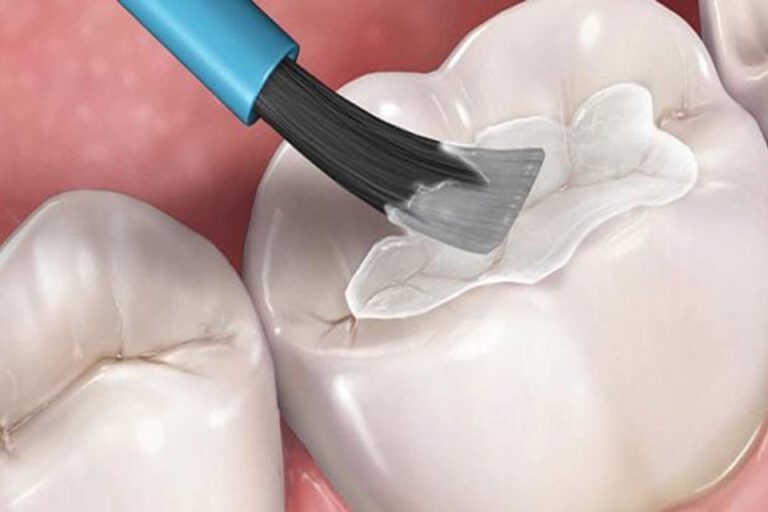
Sealing. What is that?
The word ‘seal’ is derived from the English verb ‘to seal’. It means to seal or to seal. Dental sealing therefore means sealing or sealing grooves and pits in teeth. The dentist or dental hygienist applies a layer of plastic varnish or synthetic resin cement. This can be transparent or yellowish-white.
Sealing. Why?
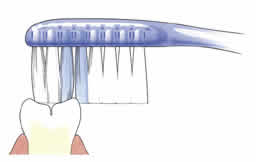 Toothbrush does not fit into the groove
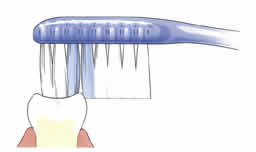 Toothbrush reaches the sealed surface
Those who brush their teeth carefully have little chance of getting cavities. Starting cavities can be stopped if you brush your teeth properly.
Sealing helps protect molars from cavities as they get bigger. It protects them in those places where they are most susceptible to cavities, namely in the grooves and pits. These are vulnerable, especially if they are deep and narrow. The bristles of the toothbrush have a hard time cleaning the grooves. Sealing is usually done shortly after the permanent molar has fully erupted. This is when cavities are most likely to occur.
What is the process of sealing?
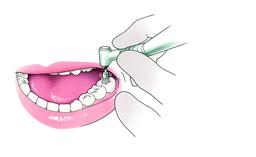 Cleaning
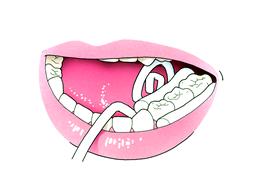 Drying
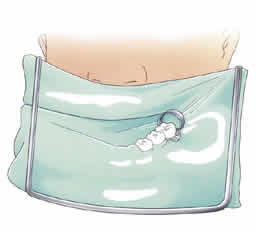 Sometimes a very thin rubber patch enters the mouth
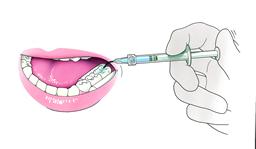 Etchings
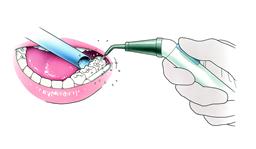 Coils
Coils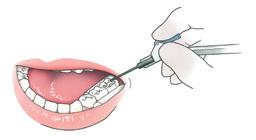 Sealing
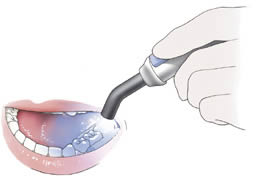 Curing the material
Cleaning
First, the dentist or dental hygienist will clean the molar thoroughly with a rotary brush or instrument.
Keep dry
Saliva prevents the coating from adhering to the molar. That's why the dentist or dental hygienist keeps the molar dry with cotton balls and a saliva aspirator. Then saliva cannot reach the molar.
Sometimes the dentist or dental hygienist stretches a very thin rubber piece around the entire molar or around several molars. This is also called rubber dam. A clamp holds the patch in place. It sometimes presses slightly on the gums, but you usually get used to it quickly. He then sprays the molar dry with an air syringe.
Etchings
To make the layer adhere properly, the dentist or dental hygienist roughens the grooves and pits in the enamel with an acidic liquid or gel. This is called etching.
Coils
After a short soaking time, the dentist or dental hygienist rinses away the acidic liquid or gel with water. This is done with an air/water syringe. The water is sucked up with a saliva aspirator.
Sealing
Now the dentist or dental hygienist can apply the layer to the molar. The applied material reaches deep into the bottom of the grooves and pits.
Curing
Then the material has to harden. This can be done by itself or with a lamp that emits blue light. If the dentist or dental hygienist uses a lamp, he sometimes protects the eyes with an orange screen. Finally, the dentist or dental hygienist checks whether the layer is properly attached.
What is the advantage of sealing?
In the sealed surfaces of the molars, there is less risk of cavities.
What are the disadvantages of sealing?
After sealing, children sometimes have a slightly foul taste in the mouth. When getting close, the molars feel a little strange at first. This sensation disappears by itself. Sealing only works on the spot where the layer is applied. It does not prevent cavities from forming in other areas of the teeth.
How do children experience sealing?
Children often experience sealing as a real treatment. Most children can tolerate it well.
What is important for my child to know?
Young children usually have difficulty keeping their mouths open for long periods of time. Tell your child how the treatment will go. If your child knows what is happening, the treatment is more likely to go smoothly.
Should each child's molars be sealed?
The molars are sealed only if the dentist expects cavities to form in the grooves.
Brushing teeth when molars are sealed
You can just keep brushing with a fluoride toothpaste. Just brush the sealed areas with it.
How long does the sealant last?
The sealant deep in the grooves lasts for several years. At the periodic check-up, the dentist or dental hygienist checks whether there is still enough present. If some material has disappeared, it can be replenished.
Want to know more?
Then download the free GezondeMond app. The app is available for Android and tablets, available via Google Play. The app for iPhone and iPad can be found in the iTunes App Store..
© Ivory Cross