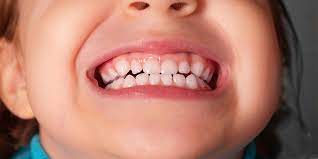
Small mouth, small teeth
A child's tiny mouth cannot accommodate adult teeth. This is why a child first gets baby teeth. The teeth are important for biting, chewing, speaking and swallowing. The baby teeth influence the development of the face and jaws. It also plays an important role in the development of permanent teeth. Read more about the changing: from baby teeth to permanent teeth.
When do children get their milk teeth?
At this age, the teeth usually erupt.
The age at which children get their teeth varies from child to child. Usually, the first milk tooth erupts between 6 and 9 months. The first 2 milk teeth appear at the bottom in the middle. These are followed by the two middle incisors at the top. The last milk molar usually appears between 24 and 30 months. A full set of milk teeth consists of 12 teeth and 8 molars. Both milk teeth and permanent teeth usually erupt in a specific order (see diagram).
When do children get their permanent teeth?
If you brush your teeth lengthwise, you will miss the new permanent molar that is coming through (photo 1). New molars are particularly vulnerable. Place the toothbrush perpendicular to the row of teeth (photo 2).
A child changes his milk teeth between the age of 6e and 13e year. Permanent ones come in place of the baby teeth and molars. Around the 6e year of life, a new permanent molar breaks through behind the last deciduous tooth. This usually happens before the front teeth change. The new molars are slightly hidden. Many children and parents do not notice the first permanent molars breaking through. The care of these molars is very important. The enamel of newly erupted molars is still very porous and vulnerable. Brush the tips of the new molars as soon as they have erupted. Around the 12e year, permanent molars break through again. They are also particularly prone to getting cavities just after breaking through. Wisdom teeth are the last molars to erupt. Full permanent teeth consist of 12 teeth and 16 molars. This does not include the wisdom teeth. They erupt later in life. Some people do not get wisdom teeth.
Are all children equally likely to have cavities?
Whether your child will get a cavity depends on how well his teeth are brushed and whether there is a lot of snacking or sweet drinking. With low sugar consumption and careful toothbrushing, any teeth can remain flawless.
Should you take good care of a baby's teeth?
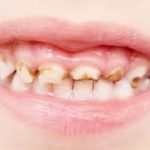
A child naturally changes their baby teeth for permanent teeth. You might think that it is therefore not necessary to take proper care of a baby's milk teeth. Nothing could be further from the truth. Poor care can cause cavities and gum disease. This can hurt, making your child eat worse, feel uncomfortable or sleep less well. Poor care of baby teeth can also affect permanent teeth. This happens, for example, when baby teeth or molars are lost prematurely. Then there is often too little space for the permanent teeth.
How can I brush my child's teeth properly?
Take your child to the dentist when their first tooth comes through.
Toddler toothbrush
The dentist or dental hygienist will give you advice on how to keep your child's teeth healthy.
To prevent tooth decay and inflamed gums in your child, it is important that you brush your child's teeth properly. Consider the following:
- Brush teeth once a day as soon as the first tooth has erupted with fluoride toddler toothpaste.
- Use a toddler toothbrush with soft bristles. The small brush easily reaches all teeth. Do not press too hard.
- For children up to 2 years old, brushing their teeth once a day is sufficient. Brush the teeth of children from 2 years of age twice a day.
- Brush in a set order according to the 3 Bs: Binnen side, BEDUCATION, Boven side. Always brush along the edge of the gums. Using the scrubbing method, brush children's teeth easily and efficiently. Make short horizontal overlapping movements. You can also use an electric toothbrush for children.
- Familiarise your child with tooth brushing in a playful way. Make it a daily recognisable ritual. Consider the beginning as a habituation phase. During this period, applying fluoride with the toothpaste is more important than getting everywhere with the brush.
- Brush the tips of new teeth that break through right away. This applies to both baby teeth and permanent teeth. The enamel of newly erupted teeth is not yet strong. They are therefore particularly sensitive to cavities.
- The first permanent molar breaks through behind the last deciduous molar. As it is lower, it is difficult to see. Brush this new molar well, too. Place the brush there at right angles to the row of teeth. Encourage children from 2 years of age to brush their own teeth as well. This will make it a habit. Brush the teeth daily, because your son or daughter cannot do it well enough yet. Keep on brushing your child's teeth until they are 10 years old. Make sure you have a good view into the mouth and that there is enough support for your child's head when you brush and after-brush. Try out which brushing position is most comfortable for you. For example, stand diagonally behind your child. When you support the chin with your hand, the head rests against your upper body. Bend over your child slightly so you can see where you are brushing. Or stand in front of your child and let it rest its head against the wall, for example. Support the chin with one hand while brushing with the other. This way you can easily see where you are brushing.
- When the first tooth breaks through, take your child to the dentist or dental hygienist. Then it will have enough time to get used to the environment and the people working there.
Fluoride
Fluoride is a natural substance that makes teeth less vulnerable to acid attacks by bacteria. Using the right amounts of fluoride thus helps prevent cavities in teeth. The amount of fluoride in fluoride toddler toothpaste is age-appropriate. Adult toothpaste contains more fluoride. Switch to this when your child turns 5. Or use toothpaste that says ‘child’ or ‘junior’ for children over 5. In that case, always look at the age indicated (e.g. 5-12 years).
How do eating and drinking affect milk teeth?
Choose tap water instead of sweet drinks
Almost all our food and drinks contain sugars and starches. These can be harmful to teeth. This is especially true of sticky products. Bacteria convert sugars in the mouth into acids. These acids damage the teeth. Fortunately, saliva has a protective effect. It neutralises the acid effect on teeth. But this takes time. Therefore, limit the number of times your child eats and drinks to a maximum of 7 per day. That is 3x a meal and a maximum of 4x a day a snack. Give your child savoury rather than sweet things. Try not to get your son or daughter used to sweets and do not add sugar to food and drinks. Choose tap water instead of sweet drinks. While light soft drinks do not cause cavities, remember that these, as well as sugary varieties, can still be acidic. Acidic products can also cause damage to teeth if consumed frequently. We call this damage tooth erosion.
I prefer a cup to a bottle.
From 9 months, use a spoutless cup instead of a feeding bottle or non-spill cup. If necessary, use a spouted cup first as an intermediate step. In the evening and at night, drinking from a baby bottle with sweet contents or milk is especially harmful. At night, there is less saliva to protect your teeth. You can always take a bottle of water to bed with you. Frequently munching on a baby bottle or anti-spill cup with, for example, fruit juice, syrup, drinking yoghurt or other milk products can damage teeth. The teeth come into prolonged contact with sugars. This makes (baby bottle) caries more likely. Let your child drink their sweet drinks in one go. Choose tap water more often instead of sweet drinks.
Rather a dummy than a thumb
Dental teat
Sucking is a natural, instinctual need of a baby. Children like to suck their thumb or a teat. Usually, this does not cause any problems for the milk teeth. When the permanent incisors erupt, sucking can push the upper teeth and jaw forward. Does your baby thumb? If so, prefer to give a dental teat. A child will put its thumb in its mouth faster and more often. This is because a dummy can easily be removed. This is another reason why sucking the nipple is usually easier to unlearn. In any case, stop thumb or dummy sucking as early as possible, but at least before the permanent teeth have erupted.
Want to know more?
Then download the free app GezondeMond. The app is available for Android and tablets, available via Google Play. The app for iPhone and iPad can be found in the iTunes App Store..
© Ivory Cross